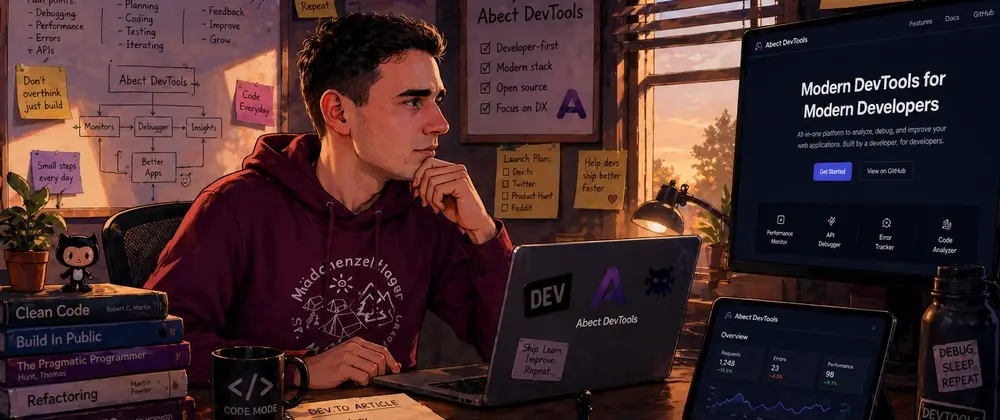
Roman Popovych — Full-Stack Software Engineer, creator of Abect Dev Tools

About Abect Dev Tools

A privacy-first collection of browser-based developer tools — built by an engineer, for engineers. No accounts, no uploads, no surprises.

Why This Project Exists

While working on a client project for a sock e-commerce brand, I needed to convert dozens of product photos to WebP. The first converter I found was buried in contextual ads — and after downloading, every filename had been renamed to that site's own domain. The next tool had a 5-file free tier limit. That afternoon I started building this.

The core problem is not any single tool — it is the pattern: mandatory uploads to unknown servers, watermarks on output, aggressive paywalls at exactly the moment you need to get work done, and no way to know what happens to client assets after upload. For anyone handling client files, that is not acceptable.

The goal was not to build another SaaS. It was to build a set of tools that work instantly, locally, and predictably — without relying on external services for anything the browser can already do.

How It Works — All Processing Stays in Your Browser

Every tool runs entirely client-side. When you drop a file, it is read by the File API directly in the browser tab — no network request is made. The Canvas API handles all image transformations: format conversion, compression, cropping, and quality adjustment. The result is exported via the Blob URL API as an in-memory download — again, no upload, no server round-trip.

You can verify this yourself: open DevTools → Network tab, drop a file into any tool, and watch. No file transfer requests will appear. The tools also work offline once the page has loaded.

Other APIs in use: Web Crypto API for collision-free file IDs, TypedArrays for binary ICO construction in the favicon generator, and JSZip for in-browser batch ZIP archives.

About the Creators

Roman Popovych
Full-Stack Software Engineer · Ukraine

3+ years building production-grade fintech systems where correctness and security are non-negotiable. I have shipped P2P lending platforms, KYC pipelines with biometric verification, banking API integrations (OAuth 2.0, PKCE), and hardened multi-instance infrastructure. Abect Dev Tools started in April 2026 as a practical fix to a frustrating afternoon — and turned into a project I keep building.
Fintech SystemsP2P LendingKYC & BiometricsNode.jsMongoDBRedisBanking APIsOAuth 2.0 / PKCEVPS HardeningmTLSZero TrustBrowser APIsCanvas API
Belskyi Vadym
Full-Stack Developer · Founder & CEO of Gray Lynx Team · Ukraine

4+ years building full-stack web applications and high-performance iGaming creatives, specializing in React, Node.js, Pixi.js, and WebGL. I ran the complete QA audit of Abect Dev Tools — testing all 50 pages for SEO compliance, Lighthouse scores, and functional accuracy across every converter. The frontend test report I wrote surfaced every functional bug and SEO issue addressed in this release.

Full-Stack DevelopmentPlayable AdsiGaming CreativesReactNext.jsNode.jsMongoDBExpressJS/TSPixi.jsMatter.jsGSAPThree.jsWebGLTelegram BotsDiscord BotsTwitch BotsGray Lynx Team

Product Principles

Privacy-first
User data is processed locally whenever possible. Files never leave your device.
No mandatory backend
All core tools work offline and in-browser. A backend may appear for optional advanced features — never for the basics.
No registration required
Open a tool, use it, done. An account system may come later for optional features — using the tools will never require it.
No ads, no tracking by default
Analytics load only if you explicitly accept cookies via the consent banner.
Predictable behavior
Tools do exactly what they claim — no surprises, no hidden operations.
Specialized AI for narrow tasks
General-purpose AI hallucinates on structured tasks — wrong schema properties, missing required fields, invalid formats. Our AI tools use constrained system prompts engineered for a specific task so the output is valid on the first try. Core browser tools remain free and account-free forever.

Open Source

The full source code is publicly available on GitHub. Anyone can read the implementation, verify that no data is transmitted, and submit new tools. Contributions follow the project's core principles: prefer client-side execution, avoid unnecessary data transfer, keep implementations focused on a single task.

View project source on GitHub →

Contact

Email: support@abect.com

Privacy Policy · Terms of Service · Report a security issue

Frequently Asked Questions

Is Abect Dev Tools completely free?
All browser-based tools — image converters, compressors, text converters, schema form generators — are completely free with no limits, no paywalls, and no watermarks. AI-powered tools require a free account and use a token-based model: the free plan gives 100,000 tokens per month at no cost, which covers hundreds of schema generations. No credit card required.
Do my files get uploaded to any server?
No. All processing happens entirely in your browser using the Canvas API and File API. Your files never leave your device. You can verify this by opening DevTools → Network tab while using any tool — no file transfer requests will appear. The tools also work offline after the page has loaded once.
Who built this and why?
Abect Dev Tools was built by Roman Popovych and Belskyi Vadym — full-stack engineers from Ukraine. The project started in April 2026 after a frustrating afternoon converting client photos: the first tool was buried in ads and renamed every downloaded file to its own domain, the next had a 5-file free tier limit. The goal was a unified toolkit that works instantly, locally, and without any of those friction points.
How can I contribute a new tool?
The project is open source. Contribution guidelines are defined in the repository — each tool must be browser-based, free, focused on a single task, and must not upload user data. Open an issue first if you are unsure whether a tool fits, then submit a pull request following the contribution guide.
What technologies power the tools?
All tools use modern browser APIs with no third-party processing services. Core APIs: Canvas API for image transformations and exports, File API for reading files locally, Blob URL API for in-memory downloads, Web Crypto API for unique ID generation, and TypedArrays for binary file construction (ICO format). JSZip handles in-browser batch ZIP archives.
How can I verify that my files really are not uploaded?
Open your browser DevTools, switch to the Network panel, and use any of the browser tools. No request carrying image or text data will appear — you will see the page assets load once and nothing after that. A stronger test: load the page, disconnect from the network entirely, and keep using the tool. It continues to work, because there is no server for it to reach.
Will the browser tools ever require an account or start charging?
No. Every browser-based tool is free, account-free, and stays that way — there is no server cost behind them to recover, because they run on your own device. The Lora AI assistant is a separate product with its own economics: it calls a paid AI API, so it needs an account and a token allowance. That distinction is deliberate and permanent, not a step towards putting the converters behind a login.
Why are the pages so fast even though this is a React site?
Every page is prerendered to static HTML at build time. The server sends a fully formed document with all the text, headings and structured data already in it, so the browser paints immediately and search engines index the content without executing any JavaScript. React then hydrates on top to make the tool interactive. There is no server rendering at request time and no database query in the critical path.
What happens to my data if I use Lora, the AI assistant?
Lora is the only part of the site that sends anything to a server. Your messages and conversation history go to the DeepSeek API to generate a reply, and are stored in our database linked to your account so you can return to the conversation. They are never used for training or advertising. You can delete individual conversations, or delete your account to remove everything permanently. The full detail is in the Privacy Policy.
Can I use the generated files commercially?
Yes. Anything the tools produce — converted images, compressed files, favicon packages, meta tags, JSON-LD schema — is yours, with no attribution requirement, no watermark and no licence attached. The tools only transform files you already own; we never see them, so we could not claim anything over them even if we wanted to.